

Flying Fiber Laser Marking on Production Lines: What Manufacturers Are Asking for in 2026
Release time:
2026-10-09
Production lines are operating at increasingly faster speeds, while industrial traceability regulations grow stricter by the year. For most manufacturing plants, the traditional workflow of pausing conveyor belts, marking parts and resuming operation is no longer efficient or viable. This is the core reason why inline flying laser marking has evolved from a niche auxiliary process to a standard mandatory solution across multiple industrial sectors. This industry shift is not exclusive to large-scale manufacturing factories. Small and mid-sized metal processing workshops, packaging enterprises and electronic assembly plants are also actively adopting flying fiber laser marking systems. The core demand is simple: boost hourly marking output significantly without adding extra production shifts or manual labor costs.
Production lines are operating at increasingly faster speeds, while industrial traceability regulations grow stricter by the year. For most manufacturing plants, the traditional workflow of pausing conveyor belts, marking parts and resuming operation is no longer efficient or viable. This is the core reason why inline flying laser marking has evolved from a niche auxiliary process to a standard mandatory solution across multiple industrial sectors.
This industry shift is not exclusive to large-scale manufacturing factories. Small and mid-sized metal processing workshops, packaging enterprises and electronic assembly plants are also actively adopting flying fiber laser marking systems. The core demand is simple: boost hourly marking output significantly without adding extra production shifts or manual labor costs.
Why Inline Marking Is Moving from Optional to Standard
Just a few years ago, standalone laser marking stations were sufficient to meet the production needs of most small workshops. Operators only needed to place parts under the laser lens, press the control pedal and wait for marking completion. This manual mode works perfectly for low-volume, intermittent production, yet it falls short for high-speed assembly lines that require consistent marking of parts every few seconds on moving conveyors.
Current market demands stem from diverse industrial scenarios. Food and beverage producers need clear date codes and batch numbers printed on bottle caps, product labels and packaging films. Pharmaceutical manufacturers require high-contrast, durable codes on drug cartons and blister foil packaging. Electronic and hardware factories need precise QR codes and serial numbers on tiny connectors, screws and metal housings. Across all these applications, the markings must be permanent, machine-readable, and completed without disrupting continuous production line operation.
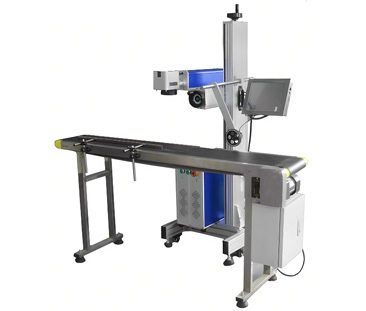
Flying fiber laser marking handles this challenge perfectly by pairing photoelectric detection technology with dynamic tracking systems. The incoming product is detected in real time by the equipment, which automatically tracks its moving position and completes laser marking while the product stays in motion. It eliminates production pauses and manual part positioning, enabling fully continuous, uninterrupted marking operations instead of inefficient stop-start cycles.
Where Flying Fiber Markers Fit Best
While versatile, the flying fiber laser marker is not a one-size-fits-all solution for all marking tasks. It delivers optimal performance for continuous production line scenarios that require lightweight marking, including product codes, brand logos, serial numbers and batch information. For deep engraving processing on heavy industrial castings, stationary fiber marking machines equipped with rotary axes remain a more practical choice.
Even so, its applicable scenarios are far broader than most equipment buyers anticipate. In the packaging industry, it supports marking on coated paper, cardboard, PET materials and flexible packaging films. For metal processing, it works stably on stainless steel, aluminum, brass and electroplated surfaces. Adopting a 1064nm laser wavelength, the equipment delivers excellent marking effects on most metals and common plastics; only dark or heavily pigmented plastic materials require pre-production sample testing for effect confirmation.
Typical inline production application scenarios cover multiple core industries:
- Food and beverage industry: Bottle caps, metal cans, product labels and outer packaging cartons
- Pharmaceutical and personal care industry: Medicine cartons, cosmetic tubes and foil packaging materials
- Electronics and hardware industry: Precision connectors, terminals, miniature stamped parts and small hardware tools
- Automotive parts industry: Mounting brackets, fasteners and under-hood precision components
Compared with traditional solid-state marking equipment, the Flying Fiber Laser Marking Machine features a more compact structure and smaller footprint. Most models adopt an air-cooled design, removing the need for an independent water chiller and greatly simplifying on-site installation and docking with existing production lines.
H2: What to Check Before Choosing a Flying Marking System
Production line speed is the primary parameter to verify before equipment selection. The operating speed of inline laser marking system ranges from 5 m/min to 100 m/min based on different application needs, but the actual achievable marking speed is restricted by three key factors: marking content complexity, character height and workpiece material. For example, fine and detailed QR codes take longer to mark than simple date codes, which directly affects overall line speed.
Marking range is another critical consideration. The standard 100mm×100mm engraving range is widely used, with optional specifications of 50mm×50mm, 150mm×150mm and 200mm×200mm available. For production lines with frequently changing product sizes, an adjustable focal lens or expanded marking field can effectively reduce equipment debugging and model changeover time. With a minimum character height of 0.15mm and repeated positioning accuracy of ±0.002mm, the equipment meets the ultra-precision marking needs of tiny electronic components, while the maximum 100mm character height adapts to large-area marking on cartons and equipment panels.
Software functions and line integration compatibility cannot be overlooked either. Practical traceability functions including real-time online editing, QR code and barcode generation, and 4–20 digit variable chaotic code coding are essential for industrial production. Meanwhile, the laser marking equipment needs to be compatible with existing factory PLC and conveyor control systems to avoid complicated secondary customized development.
Environmental adaptability also matters for long-term stable operation. The IP54 protection grade and air-cooled structure allow the equipment to operate normally in dusty and humid production workshops, with stable working conditions within 5–45°C and 10%–90% non-condensing humidity range.
H2: Integration and Support Beyond the Machine
High-quality marking results depend not only on equipment performance, but also on professional on-site integration. Multiple factors including mounting height, focal distance, laser trigger timing and conveyor speed synchronization directly affect marking clarity and consistency. To eliminate pre-purchase concerns, Udibo provides free sample marking tests for customers, allowing you to verify actual marking contrast and production cycle efficiency on your own workpieces before finalizing procurement.
For global overseas clients, efficient remote support is the key to rapid production launch. Our professional team provides one-stop WhatsApp video guidance for equipment installation, parameter debugging and daily troubleshooting. We can also sort out CE certification and other customized qualification documents according to the market access requirements of different regions. In addition, we support spare parts fast delivery and full OEM/ODM customization services for system integrators and private-label suppliers.
As a professional supplier of laser marking solutions, Udibo offers more than just flying marking machines. We also provide supporting laser equipment including laser cleaning machines for workpiece surface pretreatment and laser welding machines for post-assembly processing, as well as laser cutting equipment for special process needs. We always adhere to matching the most suitable laser process solution for customers’ actual production scenarios.
What This Means for Buyers in 2026
The development trend of industrial marking is extremely clear for 2026: more industrial products require permanent, machine-identifiable marking, production lines maintain high-speed continuous operation, and manufacturers are eager for marking solutions that do not become production bottlenecks. For small and medium-sized enterprises that pursue flexible production and low capital investment, the flying fiber laser marking machine is undoubtedly the most cost-effective and practical choice.
To avoid the common procurement pitfalls of over-specification or insufficient power, customers are advised to prepare three key materials before requesting a quote: actual workpiece samples, detailed marking content requirements and stable production line speed data. With these core parameters, our technical team can accurately recommend the most suitable laser power, lens configuration and integration scheme for your production line.
Contact Information
Udibo Industrial Machinery Co., Ltd. Suzhou Industrial Park, Jiangsu, China
Phone/WhatsApp: +86 152 5267 7152
Email: info@udibomfg.com
Website: www.udibomfg.com
© 2026 Udibo Industrial Machinery Co., Ltd. All Rights Reserved
Specialists in Laser Marking, Welding, Cleaning and Cutting Equipment
Key words:
- All
- Product Management
- News
- Introduction
- Enterprise outlets
- FAQ
- Enterprise Video
- Enterprise Atlas
Recommend News




Contact Us
Phone: +86 (China) 152-5267-7152
WhatsApp: +86 (China) 152-5267-7152
E-mail:info@udibomfg.com
Address: Building 1002 Redstar International Technology Park, Mudu Town, Wuzhong District, Suzhou City, Jiangsu Province, China