


Why Small Fabrication Shops Are Switching to Handheld Laser Welders in 2026
Release time:
2026-05-18
The global sheet metal fabrication market is projected to reach $91 billion in 2026. Yet small and medium-sized shops face persistent challenges: rising labor costs, a shortage of skilled welders, and pressure to deliver faster turnaround. In response, many are turning to handheld laser welding technology. The handheld laser welding machine market is growing at a remarkable 22.4% compound annual rate, expected to reach $2.53 billion by 2032. What is driving this shift? For small workshop owners, the advantages are increasingly clear: higher speed, lower operating costs, a much shorter learning curve than TIG or MIG, and consistently better weld quality.
The global sheet metal fabrication market is projected to reach $91 billion in 2026. Yet small and medium-sized shops face persistent challenges: rising labor costs, a shortage of skilled welders, and pressure to deliver faster turnaround. In response, many are turning to handheld laser welding technology.
The handheld laser welding machine market is growing at a remarkable 22.4% compound annual rate, expected to reach $2.53 billion by 2032. What is driving this shift? For small workshop owners, the advantages are increasingly clear: higher speed, lower operating costs, a much shorter learning curve than TIG or MIG, and consistently better weld quality.
Speed: Up to 8 Times Faster Than TIG
Traditional TIG welding runs at 0.1 to 0.8 meters per minute, depending on material thickness. Handheld laser welders can achieve 2 to 20 meters per minute—up to 8 times faster. For a shop producing stainless steel enclosures, custom brackets, or sheet metal components, this speed difference translates directly into shorter lead times, higher daily output, and improved profitability.
Unlike TIG, which requires precise torch angle and filler rod control, laser welding uses a focused beam that moves quickly and consistently. The result is less operator fatigue and more parts per shift.
Lower Operating Costs and Fast Payback
Compared to TIG or MIG methods, laser welding reduces shielding gas consumption by 30-40% and welding wire usage by 10-15%. There is virtually no spatter, so post-weld grinding is often eliminated. Lower labor requirements and fewer consumables add up quickly.
A 1500W handheld laser welder with chiller typically costs between 8,000. Based on labor and consumable savings alone, many small shops achieve full payback within 3 to 4 months. For a busy fabrication business, that is a compelling return on investment.
Weld Quality: Smooth, Clean, and Minimal Distortion
Laser welding produces smooth, consistent weld beads with minimal spatter and a very small heat-affected zone (HAZ). This means thinner sheet metal—down to 0.5 mm—can be welded without burn-through, warping, or visible distortion.
The clean appearance often requires no secondary finishing. That saves hours of grinding and polishing, especially on visible components like handrails, furniture frames, or automotive parts.

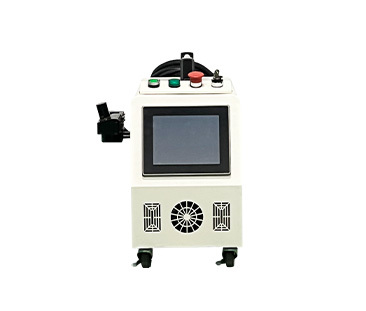
Handheld laser welding machine performing weld on stainless steel sheet metal in fabrication workshop
Easy to Learn: Hours Instead of Years
One of the biggest barriers to adopting new welding technology has always been training. TIG welding demands years of practice to master. Many small shops simply cannot afford to train new welders to an acceptable standard.
Handheld laser welders fundamentally change this. With intuitive touchscreen interfaces, preset parameters for common materials (stainless steel, carbon steel, aluminum, copper), and real-time feedback, new operators can produce high-quality welds after just a few hours of guided practice. This dramatically lowers the barrier to entry and allows existing staff to quickly add laser welding to their skillset.
Real-World Applications in Sheet Metal and Hardware
For small to medium-sized fabrication workshops, hardware manufacturers, and independent fabricators, a handheld laser welder handles a wide range of daily jobs:
Control cabinets and electrical enclosures. Welding thin-gauge stainless or mild steel panels without marks or distortion.
Custom brackets and mounting hardware. Strong, aesthetic welds on visible components, no grinding needed.
Furniture frames and shelving systems. Clean, consistent welds on tubular sections and flat stock.
Handrails, guardrails, and architectural metalwork. Uniform weld appearance across long runs.
Automotive repair and restoration. Precision welding on body panels, brackets, and exhaust components.
Small parts manufacturing and prototyping. High-accuracy welding on complex geometries.
Versatility Across Metals
A quality handheld laser welder can join a wide range of metals: stainless steel, carbon steel, copper, aluminum, gold, silver, chromium, nickel, titanium, and tantalum. Typical welding thickness ranges from 0.5 mm to 6 mm, depending on material and machine power. This versatility makes it a true all-in-one tool for any fabrication shop.
Environmental and Safety Advantages
Laser welding generates minimal fumes compared to arc welding, consumes less energy per weld, and typically requires no filler material or shielding gas for many applications. There is no spatter or slag, eliminating the need for chemical cleaning or abrasive blasting.
Modern handheld laser welders include multiple safety interlocks, automatic shutoff, and require only laser safety glasses and a designated work area. Compliance with tightening environmental regulations becomes easier, not harder.
What Small Shops Should Consider Before Buying
Power selection. 1000W to 2000W units cover most sheet metal applications, including stainless, carbon steel, and aluminum up to 5-6 mm thick.
Cooling. Water-cooled systems offer stable continuous operation for production environments.
Training and support. Choose a supplier that provides onsite or remote training, clear documentation, and responsive customer support.

Portable fiber laser welding machine joining thin metal sheet with smooth weld bead
The Bottom Line
Handheld laser welding is no longer a futuristic technology—it is a practical, affordable tool that is already transforming small fabrication shops. Faster production, lower costs, better weld quality, and a dramatically shortened learning curve make it an essential investment for 2026 and beyond.
For shop owners who have been watching from the sidelines, the question is no longer whether to adopt laser welding, but when. With payback measured in months and barriers to entry lower than ever, now is the time to take a closer look.
Contact Information
Udibo Industrial Machinery Co., Ltd.
Suzhou Industrial Park, Jiangsu, China
Phone/WhatsApp: +86 152 5267 7152
Email: info@udibomfg.com
Website: www.udibomfg.com
© 2026 Udibo Industrial Machinery Co., Ltd. All Rights Reserved
Specialists in Laser Marking, Welding, Cleaning and Cutting Equipment
- All
- Product Management
- News
- Introduction
- Enterprise outlets
- FAQ
- Enterprise Video
- Enterprise Atlas
Recommend News




Contact Us
Phone: +86 (China) 152-5267-7152
WhatsApp: +86 (China) 152-5267-7152
E-mail:info@udibomfg.com
Address: Building 1002 Redstar International Technology Park, Mudu Town, Wuzhong District, Suzhou City, Jiangsu Province, China