

From Labels to Lasers: How Flying Fiber Laser Marking is Transforming Food & Beverage Packaging
Release time:
2026-05-25
The food and beverage industry is under more pressure than ever. Between tightening global regulations, rising consumer demand for product transparency, and the urgent need to eliminate packaging waste, manufacturers at every scale — from global bottlers to local food producers — are rethinking how they mark their products. Expiration dates, batch codes, QR trackers, and brand logos that once relied on labels or inkjet printing are now shifting toward a cleaner, more permanent solution: laser marking. As the global coding and marking market expands from 8.62billion in2025to aprojected11.79 billion by 2030, laser technologies are leading the way1. But how exactly does a flying fiber laser marking machine work on a fast-moving line — and why are small and medium-sized packaging operations making the switch right now? Let‘s walk through the real-world trend, the technology itself, and what it means for businesses looking to stay competitive.
The food and beverage industry is under more pressure than ever. Between tightening global regulations, rising consumer demand for product transparency, and the urgent need to eliminate packaging waste, manufacturers at every scale — from global bottlers to local food producers — are rethinking how they mark their products. Expiration dates, batch codes, QR trackers, and brand logos that once relied on labels or inkjet printing are now shifting toward a cleaner, more permanent solution: laser marking. As the global coding and marking market expands from 11.79 billion by 2030, laser technologies are leading the way1. But how exactly does a flying fiber laser marking machine work on a fast-moving line — and why are small and medium-sized packaging operations making the switch right now? Let‘s walk through the real-world trend, the technology itself, and what it means for businesses looking to stay competitive.
Why Marking Matters More Than Ever in 2026
Just a few years ago, a simple printed date code or a peel-off label might have been enough. Today, regulatory bodies across North America, Europe, and Asia are tightening traceability requirements. The EU’s Packaging and Packaging Waste Regulation (PPWR), approved in January 2025, now mandates clear and permanent packaging labeling for recyclability, with GS1‑compliant QR codes becoming the new standard50. Meanwhile, the FDA’s Food Safety Modernization Act (FSMA) requires robust records that allow for rapid trace‑back and trace‑forward of food products19. For packaging lines that handle beverages, dairy, snacks, or frozen foods, the message is clear: labels that fall off and ink codes that smudge or fade are no longer acceptable. This regulatory push, combined with the anti‑counterfeiting crisis costing the food industry an estimated $40 billion annually, has made permanent, high‑contrast, machine‑readable coding a non‑negotiable part of food safety42.
From Ink to Laser: What’s Driving the Switch on Production Lines
For decades, continuous inkjet (CIJ) was the default choice for high‑speed packaging. And for many applications, it still works. However, the total cost of ownership tells a different story. CIJ printers require solvents, frequent cleaning, ink cartridges, and replacement parts. Over a year of continuous operation, those consumable costs add up significantly. More importantly, inkjet printing struggles in challenging environments. When high‑speed beverage lines run aluminum cans through condensation or damp chillers, ink droplets can scatter, causing unreadable codes and production delays19. Laser marking solves these issues at the root. A flying fiber laser marking machine uses a focused beam of light to etch or discolor the surface of the material directly — no ink, no solvents, no drying time, and no consumables beyond electricity. The result is a permanent, high‑contrast mark that withstands moisture, abrasion, and temperature changes. From a cost perspective, the upfront investment in a laser marking machine is higher than a basic CIJ printer, but the long‑term savings are undeniable: zero ink costs, almost zero maintenance, and consistently readable codes that keep production lines running.
Flying Laser Marking in Action: Real‑Time Coding on Beverage and Food Lines
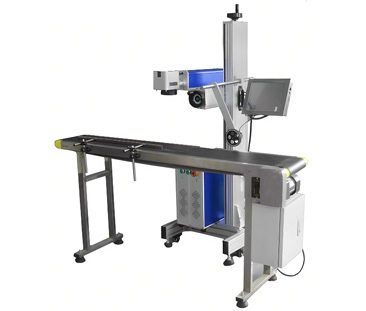
So, how does online laser marking work on a fast‑moving packaging line? A flying fiber laser marking machine is designed to mount directly above a conveyor, integrating with photoelectric sensors that detect each product as it passes. When a can, bottle, carton, or pouch moves into the marking zone, the laser fires a precisely timed burst, engraving a production date, batch number, QR code, or logo in milliseconds — without stopping the line. The marking speed can be adjusted from 5 meters per minute up to 100 meters per minute, depending on the material and code complexity. In real‑world use, fiber laser marking has been proven on high‑capacity beverage lines where condensation on aluminum cans previously caused ink to smear. By switching to fiber laser coding, manufacturers achieved stabilization of print quality at line speed while completely eliminating sensitivity to wet surfaces19.
What materials can a laser marking machine handle in the food and beverage sector? A fiber laser marking machine with a 1064nm wavelength is ideal for marking metals (aluminum cans, bottle caps, metal lids), hard plastics (HDPE, PET, polypropylene containers), and coated foils. For applications involving heat‑sensitive materials or pharmaceutical blister packs, a UV laser offers a cold‑marking alternative with minimal thermal impact. And for paper‑based boxes, labels, and films, a CO₂ laser delivers crisp, high‑contrast marks without burning through the substrate. The flexibility means that a single inline laser marking system can handle dozens of product SKUs across a single shift, from dairy cartons to glass jars to flexible pouches.
A Smart Investment for Small and Midsize Operations
One of the biggest misconceptions about laser marking machine technology is that it’s only for massive, automated factories. In reality, modern flying laser marker systems are compact, user‑friendly, and surprisingly affordable for small to medium‑sized operations. For a family‑owned beverage bottler, a local meat processor, or a mid‑size snack producer, switching from labels or inkjet to laser coding reduces three major costs at once: label inventory and storage, ink and solvent purchases, and the labor time spent cleaning printheads and replacing cartridges. The training curve is minimal — most operators can learn the basic software interface in less than a day. The compact design of a flying laser marking machine also means it fits easily onto existing conveyor lines without major reconfiguration. For entrepreneurs launching a new packaged food line or small co‑packing facility, starting with a laser marking machine rather than traditional coding equipment means lower recurring costs and a cleaner, more sustainable production process from day one.
Beyond Compliance: Traceability, Anti‑Counterfeiting, and Sustainability
Coding and marking are no longer just about adding a date to a package. Today, laser‑engraved GS1‑compliant QR codes and DataMatrix codes allow consumers, retailers, and regulators to scan a product and instantly see its origin, production batch, and expiration details. This level of traceability is becoming a legal requirement in many export markets — from the EU’s PPWR to updated food safety laws in Southeast Asia. For brands, laser marking provides an extra layer of anti‑counterfeiting protection. Engraved codes cannot be removed, altered, or replaced without visible damage to the packaging — a critical advantage in markets where counterfeit food and beverage products pose serious health and reputational risks42. And from an environmental standpoint, laser coding eliminates the waste associated with ink cartridges, solvents, ribbons, and label backing paper. For food and beverage companies looking to reduce their carbon footprint and meet sustainability reporting goals, switching to a fiber laser marking machine is one of the fastest, most visible improvements available.

FAQ
Q: Is a flying fiber laser marking machine difficult to integrate into my existing packaging line?
A: Not at all. Flying laser marker systems are designed for simple retrofit. The marking head mounts above your existing conveyor, connects to a photoelectric sensor, and integrates with your production PLC. Most installations can be completed in a single shift with minimal line downtime.
Q: Will laser marking damage food‑grade packaging materials?
A: No. When properly configured, laser marking only affects the surface layer of the material — removing a coating, creating a contrast, or lightly engraving without penetrating the substrate. For sensitive applications like food contact surfaces, UV laser markers offer a cold‑marking process that generates minimal heat and meets food safety standards.
Q: What is the typical return on investment for switching from inkjet to laser?
A: While the upfront cost of a laser marking machine is higher than a basic CIJ printer, most users recover their investment within 12 to 24 months through eliminated ink and solvent purchases, reduced maintenance labor, and lower downtime from printhead clogs. For high‑volume packaging lines, the payback period is often even shorter.
Contact Information
Udibo Industrial Machinery Co., Ltd.
Suzhou Industrial Park, Jiangsu, China
Phone/WhatsApp: +86 152 5267 7152
Email: info@udibomfg.com
Website: www.udibomfg.com
© 2026 Udibo Industrial Machinery Co., Ltd. All Rights Reserved
Specialists in Laser Marking, Welding, Cleaning and Cutting Equipment
For More Information and a Free Quote
Is your food or beverage packaging line ready for the switch to laser coding? Whether you‘re running a small co‑packing operation or managing a high‑speed beverage facility, our flying fiber laser marking machine delivers permanent, compliant, cost‑saving marks — without consumables, without downtime, and without compromise. Visit our official website or contact us via email for a free consultation and customized quote tailored to your production volume and packaging materials.
Key words:
- All
- Product Management
- News
- Introduction
- Enterprise outlets
- FAQ
- Enterprise Video
- Enterprise Atlas
Recommend News




Contact Us
Phone: +86 (China) 152-5267-7152
WhatsApp: +86 (China) 152-5267-7152
E-mail:info@udibomfg.com
Address: Building 1002 Redstar International Technology Park, Mudu Town, Wuzhong District, Suzhou City, Jiangsu Province, China