


Portable Pulsed Laser Cleaning: A Smarter Way to Handle Rust, Paint, and Mold Residue
Release time:
2026-09-24
For decades, workshops and maintenance teams have relied on sandblasting, chemical strippers, or hand grinders to remove rust, paint, and surface contamination. These methods work—but they come with hidden costs: abrasive media to buy and dispose of, chemical waste to manage, and the constant risk of damaging the base material. A newer approach is gaining ground across industrial maintenance: portable pulsed laser cleaning. This laser cleaning machine technology uses short, high-energy light pulses to break the bond between contaminants and the substrate, leaving the underlying metal intact. The global handheld laser cleaning equipment market was valued at approximately US$346 million in 2025, with steady growth projected through 2031. Much of that momentum comes from small and mid-sized operations that need a practical, affordable alternative to traditional surface preparation.
For decades, workshops and maintenance teams have relied on sandblasting, chemical strippers, or hand grinders to remove rust, paint, and surface contamination. These methods work—but they come with hidden costs: abrasive media to buy and dispose of, chemical waste to manage, and the constant risk of damaging the base material. A newer approach is gaining ground across industrial maintenance: portable pulsed laser cleaning. This laser cleaning machine technology uses short, high-energy light pulses to break the bond between contaminants and the substrate, leaving the underlying metal intact. The global handheld laser cleaning equipment market was valued at approximately US$346 million in 2025, with steady growth projected through 2031. Much of that momentum comes from small and mid-sized operations that need a practical, affordable alternative to traditional surface preparation.
Why Pulsed Laser Cleaning Is Different from Continuous-Wave Systems
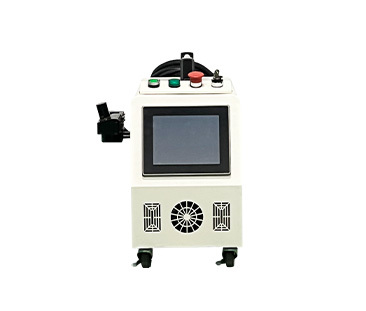
Not all laser cleaning machine systems work the same way. Continuous-wave (CW) lasers deliver a steady beam, which is effective for heavy rust removal but can generate enough heat to warp thin panels or alter heat-sensitive alloys. Pulsed fiber lasers, by contrast, concentrate energy into nanosecond-scale bursts. That means the contaminant absorbs the energy and vaporizes while the base metal stays cool. This distinction matters most for precision work: mold maintenance, weld preparation on aluminum, and cleaning of thin-walled components. A 100W pulsed unit is specifically matched to light surface cleaning, mold restoration, and delicate substrates—jobs where a CW laser would be overkill, and traditional media blasting too imprecise. For workshops handling a mix of materials and contamination levels, this balance of control and portability is often the deciding factor.

Where Portable Pulsed Cleaning Makes the Biggest Difference
Shipbuilding and marine maintenance is one of the most demanding environments for surface preparation. Hulls, decks, and structural steel are exposed to saltwater, coatings, and corrosion year-round. Sandblasting in confined spaces is often impractical, and the waste stream it produces creates disposal headaches. Pulsed laser cleaning removes marine growth, salt deposits, and rust without abrasive media, which reduces secondary waste and protects the surrounding environment-. A 100W handheld unit can address localized corrosion on deck fittings, weld seams, and equipment housings—areas that would otherwise require disassembly or chemical treatment.
Mold maintenance is another area where pulsed laser cleaning has become a practical tool. Tire molds, injection molds, and rubber molds accumulate release agents, rubber residue, and oxide layers that affect part quality. Traditional cleaning methods—dry ice blasting, chemical baths, or manual scraping—are slow and can erode mold surfaces over time. A pulsed laser cleaning machine removes demolding residue with micron-level control, helping extend mold life and restore surface consistency. For mold shops that run multiple press cycles per day, the ability to clean in place without disassembly shortens downtime and keeps production moving.
The Practical Advantages for Small and Mid-Sized Operations
The business case for portable pulsed laser cleaning is straightforward once you account for the full cost picture. Laser systems have a higher upfront price than a sandblaster or chemical kit, but the ongoing costs are minimal. There is no abrasive media to purchase, no chemical strippers to store or dispose of, and no slurry waste to manage. Running costs are essentially electricity, and maintenance is limited to occasional protective lens replacement-. For a small workshop or mobile service operator, that cost structure changes the math: one machine can handle rust removal, paint stripping, weld preparation, and mold cleaning without a rotating inventory of consumables. The air-cooled design of compact pulsed units also eliminates the need for water chiller maintenance, which keeps the setup simple and the footprint small. Operators can transport the unit in a standard vehicle and set up at a customer site within minutes—a significant advantage for field service work and on-site repairs.
What This Means for the Future of Surface Preparation
The shift toward portable pulsed laser cleaning machine technology reflects a broader change in how industrial maintenance is approached. Regulatory pressure on abrasive media disposal and volatile organic compound emissions is increasing in many markets, and customers are asking for cleaning methods that do not create a waste stream-1. At the same time, the equipment itself has become smaller, lighter, and easier to operate. A 100W pulsed cleaner can be carried by one person, plugged into a standard power supply, and operated after a short training period. That accessibility is what makes it relevant not only to large shipyards and mold manufacturers but also to independent workshops, repair shops, and mobile service providers. For businesses evaluating their surface preparation options, the practical question is no longer whether laser cleaning works—it is whether the current method is costing more in consumables, labor, and rework than a pulsed laser system would.
Frequently Asked Questions
Q: Can a 100W pulsed laser cleaner remove thick rust?
A: A 100W pulsed system is best suited to light surface rust, oxide layers, paint, and mold residue. For heavy mill scale or thick corrosion, a higher-wattage CW or pulsed unit is more appropriate. Matching the wattage to the most common cleaning task avoids overspending on power you rarely need.
Q: Does laser cleaning damage the base metal?
A: Pulsed laser cleaning is non-abrasive and non-contact. The energy is absorbed by the contaminant rather than the substrate, so there is no mechanical abrasion or heat-affected zone under normal operating parameters.
Q: How long does it take to learn to operate a handheld laser cleaner?
A: Most operators can perform basic cleaning tasks after a short training session. The controls are straightforward—power, frequency, and scan width are adjusted to match the material and contamination type.
Contact Information
Udibo Industrial Machinery Co., Ltd.
Suzhou Industrial Park, Jiangsu, China
Phone/WhatsApp: +86 152 5267 7152
Email: info@udibomfg.com
Website: www.udibomfg.com
© 2026 Udibo Industrial Machinery Co., Ltd. All Rights Reserved
Specialists in Laser Marking, Welding, Cleaning and Cutting Equipment
Key words:
- All
- Product Management
- News
- Introduction
- Enterprise outlets
- FAQ
- Enterprise Video
- Enterprise Atlas
Recommend News



Contact Us
Phone: +86 (China) 152-5267-7152
WhatsApp: +86 (China) 152-5267-7152
E-mail:info@udibomfg.com
Address: Building 1002 Redstar International Technology Park, Mudu Town, Wuzhong District, Suzhou City, Jiangsu Province, China