


Bench Notes A Tire Mold's Path Through Laser Welding Repair
Release time:
2026-11-11
Mold maintenance used to leave the factory. Teams would box up damaged cavities or chipped tread segments, ship them out to external specialists, and wait roughly seven days for them to come back. This workflow is steadily shifting. Toolrooms across injection molding facilities, die-casting workshops and tire mold service providers are bringing repair tasks back inside their own walls. Downtime on idle presses carries a higher price tag than the equipment itself. For toolrooms that used to outsource every single crack repair, a mold repair laser welding machine makes practical financial sense. This write-up follows one regular workorder, tracking the mold from the workbench all the way back to production press.
Mold maintenance used to leave the factory. Teams would box up damaged cavities or chipped tread segments, ship them out to external specialists, and wait roughly seven days for them to come back. This workflow is steadily shifting. Toolrooms across injection molding facilities, die-casting workshops and tire mold service providers are bringing repair tasks back inside their own walls. Downtime on idle presses carries a higher price tag than the equipment itself. For toolrooms that used to outsource every single crack repair, a mold repair laser welding machine makes practical financial sense. This write-up follows one regular workorder, tracking the mold from the workbench all the way back to production press.
The job on the bench
Tire molds present tricky repair challenges. Fine steel ribs and narrow vent slots form the tread pattern. Surface finish around these features must remain unchanged. If not, every tire molded from that cavity will show a visible imprint. A typical incoming segment comes with worn rib profiles and a thin hairline crack right beside one vent. Shops can choose to scrap the part, or attempt repairs with a standard torch. Unfortunately, widespread heat from torch work softens nearby ribs and pushes critical dimensions out of spec. Most operators aim to preserve the original geometry. This kind of application calls for precision repair equipment, not a standard general welder.
How the workorder actually ran
Step 1 — Start with a coupon, not the mold. Operators do not lock in parameters straight on the production mold. A small scrap coupon cut from matching steel gets sent through sample tests first. Wire diameter, pulse energy and spot size are tuned and recorded. These documented settings get handed over to the machine operator. New buyers can also use this trial phase to map out their required inventory of consumables welding wire, shielding gas, spare protective lenses.
Step 2 — Clean, then look. Vent slots trap residual release agent and rubber debris deep inside. All contaminants must be cleared before applying any heat. Larger facilities commonly deploy a laser cleaning machine for this prep step. Smaller toolrooms can get acceptable results with solvent wipes and brass hand brushes. The cleaned mold segment is positioned under the CCD microscope vision system. The optical head offers manual travel of roughly 150 mm. The worktable supports loads up to 200 kg, eliminating extra rigging work for heavy mold segments. Alignment is completed under magnification instead of relying on naked-eye estimation.
Step 3 — Build up only what is missing. This bench setup uses a pulsed NdYAG mold laser welding machine operating at 1064 nm, rated for 200 W with water cooling. Its spot size is adjustable between 0.2–3.0 mm. Filler wire ranging 0.1–0.6 mm is manually fed into the melt pool under continuous argon shielding. Brief pulse durations hold the heat-affected zone tight. Rib material is deposited layer by layer, while adjacent steel stays cool enough to retain its hardness. Weld penetration is intentionally limited; the goal is restoration, not deep fusion.

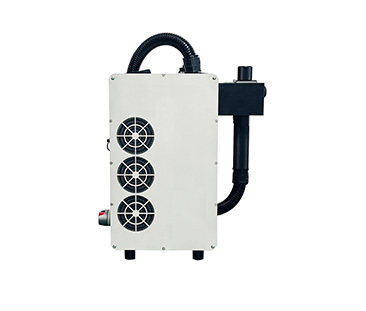
YAG mold laser welding machine rebuilding a worn tire mold rib under CCD microscope
Step 4 — Check the geometry, then the finish. After the weld bead fully cools, the rebuilt rib is stoned and polished to match the surrounding cavity surface. The weld bead itself is not the primary check point. Inspectors focus on surrounding features dimensional readings, vent slot width, and surface texture matching the original cavity profile. Low heat input delivers two clear benefits less distortion and reduced post-weld finishing work. Any part numbers removed during polishing can be re-etched with a laser marking machine.
Step 5 — Put it back, and keep it running. A repaired mold segment can return to the production press within the same shift. External welding contractors are not required for this process, which explains why the setup pencils out well for smaller toolrooms. Support logistics around the machine demand careful planning. Consumables need reliable stock replenishment. New operators receive hands-on guidance on initial jobs. A technician can join via video call to troubleshoot whenever parameters behave unexpectedly. Spare protective lenses and welding wire ship alongside the machine, rather than being ordered after an unplanned breakdown. In-house repair capacity only delivers stable returns when this support framework is planned out upfront. CE documentation can be prepared upon request. OEM and ODM builds follow custom specification sheets instead of pre-set catalogue options.
What the workorder says about the wider shift
Mold repair evaluation was once based almost entirely on weld quality. Today teams measure success by how few secondary changes occur dimensional stability, surface finish, retained hardness, and total press idle time. This becomes just as much a purchasing decision as a process decision. Shops often invest in a laser welding machine to solve one specific repair task, then discover it handles insert touch-ups, parting line fixes and small die maintenance too. Larger manufacturing sites may run laser cutting machine cells alongside tooling departments. Maintenance teams, however, prefer compact, accurate units stationed right at the repair bench.
This tire mold job was not technically complex. It was simply work that once had to leave the factory floor. Bringing repairs in-house shrinks a week-long wait down to a single afternoon. Service logs read like a straightforward checklist. It is the repair workflow at the bench, not the datasheet specifications, that is driving this industry change.
Contact Information
Udibo Industrial Machinery Co., Ltd.
Suzhou Industrial Park, Jiangsu, China
Phone/WhatsApp: +86 152 5267 7152
Email: info@udibomfg.com
Website: www.udibomfg.com
© 2026 Udibo Industrial Machinery Co., Ltd. All Rights Reserved
Specialists in Laser Marking, Welding, Cleaning and Cutting Equipment
Key words:
- All
- Product Management
- News
- Introduction
- Enterprise outlets
- FAQ
- Enterprise Video
- Enterprise Atlas
Recommend News




Contact Us
Phone: +86 (China) 152-5267-7152
WhatsApp: +86 (China) 152-5267-7152
E-mail:info@udibomfg.com
Address: Building 1002 Redstar International Technology Park, Mudu Town, Wuzhong District, Suzhou City, Jiangsu Province, China