


Handheld Laser Welding Reshapes Ship Repair: Faster, Cleaner, and More Flexible
Release time:
2026-06-30
The global ship repair industry is steadily moving away from noisy, fume-filled traditional welding bays. Tight schedules, complex steel structures, and rising environmental regulations are pushing small to mid-sized shipyards to seek cleaner, more efficient joining methods. At the heart of this transformation is the handheld laser welding machine, a portable, high-precision tool that reduces heat distortion, eliminates most post-weld grinding, and fits into the cramped corners of a vessel just as easily as it handles open-deck work.
The global ship repair industry is steadily moving away from noisy, fume-filled traditional welding bays. Tight schedules, complex steel structures, and rising environmental regulations are pushing small to mid-sized shipyards to seek cleaner, more efficient joining methods. At the heart of this transformation is the handheld laser welding machine, a portable, high-precision tool that reduces heat distortion, eliminates most post-weld grinding, and fits into the cramped corners of a vessel just as easily as it handles open-deck work.
Why Shipyards Are Switching to Portable Laser Welding
Ship maintenance has always demanded mobility. Whether repairing a corroded ballast tank stiffener or fixing a cracked handrail on a weather deck, dragging bulky arc welding equipment onto a vessel consumes hours of unproductive labor. Today, compact fiber laser systems are changing the equation. A 1500W portable unit weighs under 90 kg, can be wheeled dockside, and delivers a laser welding beam through a 10‑meter flexible fiber. The operator simply aims the handheld head, and within seconds a clean, oxidation‑free seam is formed—often without filler wire.
Environmental drivers further accelerate adoption. Traditional MIG and TIG processes produce considerable spatter, fumes, and grinding dust. The concentrated energy of a fiber laser welding machine creates an extremely narrow heat-affected zone. This means less thermal stress on surrounding steel, virtually no spatter, and a smooth weld surface that requires minimal finishing. For yards under pressure to meet ISO 14001 and similar standards, these laser‑based methods align perfectly with eco‑conscious operations.

Real‑World Marine Repair: From Hull to Hatch Cover
Consider a typical scenario: a 20‑meter fishing vessel shows pitting corrosion along the waterline strake. Conventionally, the damaged section must be cut out, a replacement plate beveled, tacked, and welded with multiple passes, then laboriously ground flush. With a handheld laser welder operating in continuous‑wave mode at 1500W, the yard team can weld the full length of a 5‑mm mild‑steel insert in a single pass at speeds up to 120 cm/min. The resulting seam is barely 2 mm wide, requires only a light scuff with a flap disc, and holds full structural integrity. The job that once consumed an entire shift now completes before lunch, letting the boat return to service faster.
The same tool adapts instantly to dissimilar metals. Replacing an aluminum‑alloy deck hatch often demands specialized TIG skills, yet a laser beam tuned to 30% power seamlessly joins aluminum to stainless steel fasteners without burn‑through. Even thin‑gauge copper piping—common in ship cooling systems—is welded without deformation, a task that frustrated traditional methods for decades. Marine workshops also use the machine for delicate tasks like attaching thermocouple bosses to exhaust manifolds or rebuilding worn pump impeller edges, operations where precision trumps speed.

Product Integration and Advantages
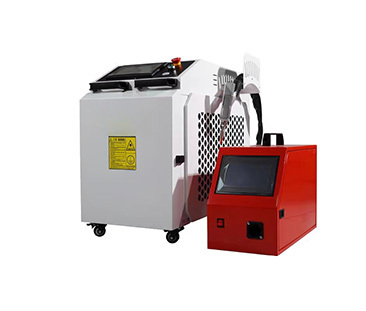
The technology described is embodied in the UDUH‑SCLMF‑21500 handheld laser welding machine, a water‑cooled system offering 1000W, 1500W, and 2000W power options. Its real‑world advantages speak directly to small and medium shipyards: no special foundation or gas‑bottle racks needed, a simple 220V/380V single‑phase connection, and an interface so intuitive that operators become proficient after one day of training. The adjustable 10‑meter fiber gives access to the deepest bilge compartments, while the optional wire feeder handles gaps wider than 0.5 mm without fuss. For ship repair enterprises where every hour of downtime costs money, the combination of low heat input, high travel speed, and near‑zero cleanup directly translates into more repair jobs per week and a rapid return on investment. Even solo operators and family‑run boat workshops can afford and operate this class of machine, bringing industrial‑grade quality within their reach.
FAQ
Q: Can a handheld laser welder reliably join 5 mm ship plate?
A: Yes. With 1500W or 2000W continuous‑wave output, it achieves full penetration on 5‑6 mm carbon steel in a single pass, producing a fatigue‑resistant, visually clean weld.
Q: Is laser welding safe in a marine environment?
A: Absolutely. The enclosed beam path, contact‑sensing safety interlocks, and the absence of open arcs or molten spatter make it one of the safest welding processes for enclosed spaces, provided standard laser‑safety eyewear is worn.
Q: How much post‑weld finishing does laser welding need?
A: Very little. The smooth, narrow bead typically requires only a quick pass with a non‑woven abrasive to meet paint‑preparation standards, saving hours of grinding labor.
Contact Information
Udibo Industrial Machinery Co., Ltd.
Suzhou Industrial Park, Jiangsu, China
Phone/WhatsApp: +86 152 5267 7152
Email: info@udibomfg.com
Website: www.udibomfg.com
© 2026 Udibo Industrial Machinery Co., Ltd. All Rights Reserved
Specialists in Laser Marking, Welding, Cleaning and Cutting Equipment
Key words:
- All
- Product Management
- News
- Introduction
- Enterprise outlets
- FAQ
- Enterprise Video
- Enterprise Atlas
Recommend News


Contact Us
Phone: +86 (China) 152-5267-7152
WhatsApp: +86 (China) 152-5267-7152
E-mail:info@udibomfg.com
Address: Building 1002 Redstar International Technology Park, Mudu Town, Wuzhong District, Suzhou City, Jiangsu Province, China